
Badminton is all about precision, strategy, and quick reflexes — but winning isn’t just about skill. It also comes down to playing on a court with the right shuttle court measurements. Whether you’re a seasoned player, a dedicated coach, or simply love the game, knowing the shuttle court measurements in feet is key to fair play. Accurate shuttle badminton court measurements not only follow the official rules but also make sure every match is consistent, enjoyable, and fair for everyone on the court.
Table of Contents
From the distance between the service lines to the height of the net, every detail plays a role in shaping the dynamics of a match. A court that meets official standards enhances the experience, allowing players to perform their best while ensuring every shot counts. By exploring shuttle court measurements, you’ll gain insights into creating an optimal playing environment that supports both competitiveness and enjoyment. Let’s take a closer look at the precise dimensions that make badminton such an exacting and exhilarating sport!
Standard Dimensions of a Badminton Court
Precision and adherence to official dimensions are vital in badminton to ensure fair play and consistency in every game. The Badminton World Federation (BWF) sets the official standards for a badminton court, defining its size, markings, and net height. Here’s a breakdown of the key measurements and their variations for singles and doubles play.
Court Dimensions
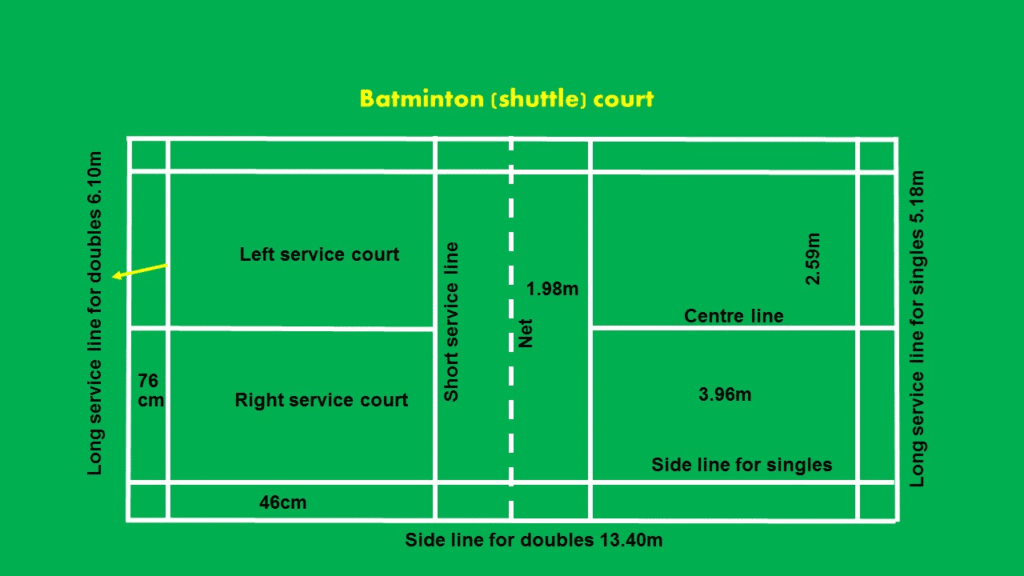
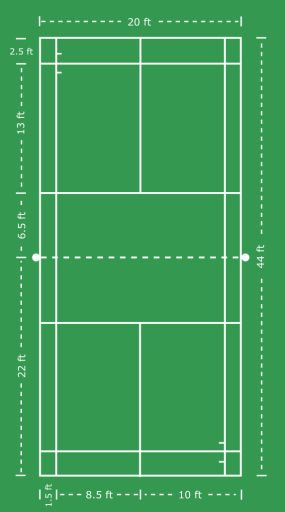
- Length: A standard badminton court measures 44 feet (13.4 meters) long. This measurement is the same for both singles and doubles matches.
- Width:
- For singles, the court width is narrower, measuring 17 feet (5.18 meters).
- For doubles, the width increases to 20 feet (6.1 meters), utilizing the full width of the court.
These differences in width create a distinct playing area for each format, with doubles requiring wider coverage.
Service Courts and Lines
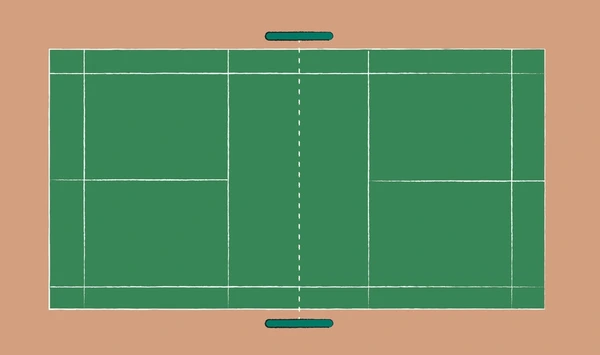
Badminton courts are divided into left and right service courts by a center line, which runs perpendicular to the net. Here are other key elements within these areas:
- The short service line is drawn 6 feet 6 inches (1.98 meters) from the net and marks the minimum serving distance.
- The long service lines differ slightly:
- For doubles, the long service line is set closer to the net, at 13 feet (3.96 meters) from the back boundary.
- For singles, it extends to the back boundary line itself, at the full court length.
Net Height
The badminton net is a critical part of the court setup. According to BWF standards:
- The net should be 5 feet 1 inch (1.55 meters) high at the edges.
- At the center, the height is slightly lower at 5 feet (1.524 meters).
This difference in height ensures fairness while maintaining the unique dynamics of the sport.
Markings and Boundaries
The boundary lines of a badminton court are an essential guide for players to understand the playable area. These lines are typically:
- 1.5 inches (40 mm) thick.
- Easily distinguishable, often marked in white or yellow to ensure visibility against the court surface.
Key Takeaways for Singles vs. Doubles
The primary distinction between singles and doubles courts lies in the width of the playing area and the placement of the long service line. Singles games focus on precision and agility with a narrower court, while doubles games demand lateral movement and teamwork over a wider space.
Understanding these standard dimensions allows players and coaches to develop strategies tailored to the game’s format while ensuring compliance with international standards. Whether you’re setting up a court or analyzing gameplay, these details are foundational to mastering the sport.
Key Sections of a Badminton Court
Understanding the layout of a badminton court is essential for players to excel in the sport. Each section of the court plays a unique role, governing where players stand, serve, and rally during a match. Here’s a breakdown of the key sections and their functions, with insights into how they differ for singles and doubles games.
1. Service Courts
The service courts are crucial during the game’s opening exchanges as they define where players must serve and receive. There are two service courts on each side of the net – a left and a right service court.
- Singles Play:
- Players alternate between the left and right service courts depending on their score.
- The service court boundaries are narrower, following the singles-specific lines.
- Doubles Play:
- Service courts are wider, using the full width of the doubles court boundaries.
- The doubles short service line is positioned closer to the net compared to singles, requiring greater precision in serves.
2. Boundary Lines
The boundary lines mark the playable area of the badminton court. They are essential for determining in-play and out-of-play shots during matches.
- Singles Court:
- The sidelines are drawn closer to the centerline, making the court narrower.
- Shots landing outside these lines are considered out of bounds.
- Doubles Court:
- The sidelines encompass the entire width of the court, providing a larger area for gameplay.
- The rear boundary line is shared with the singles court, but the long service line for doubles is drawn closer to the net.
3. Center Line
This line divides the court into two halves, separating the left and right service courts. It runs perpendicular to the net, extending from the short service line to the back boundary.
- Role in Gameplay:
- Players use the center line to position themselves correctly during serves.
- It ensures fair division of service courts for both singles and doubles play.
4. Short Service Line
The short service line is located on both sides of the net, extending parallel to it. It marks the minimum distance a shuttle must travel during a serve to be valid.
- Singles and Doubles:
- It is positioned the same for both formats, at 6 feet 6 inches (1.98 meters) from the net.
- Players must ensure serves cross this line while staying within the designated service court boundaries.
5. Rear Court
This section of the court extends from the back boundary line to the long service line for doubles. It’s crucial for executing deep defensive shots and smash returns.
- Singles and Doubles:
- The rear court is actively used throughout singles gameplay due to the focus on precision and agility.
- Doubles teams often position one player in the rear court for powerful smashes while the other manages the front court.
How These Sections Impact Gameplay
Each section of the badminton court plays a pivotal role in strategy and movement:
- Positioning during serves and rallies impacts point outcomes.
- Boundaries ensure rule compliance and fairness.
- Divisions like the centerline create clarity, making the game structured and evenly contested.
Knowing the purpose of these sections and how they differ between singles and doubles formats allows players to better understand the court and optimize their performance. Together, these sections create the foundation for a dynamic and fast-paced game.
Net Specifications for Badminton
The badminton net is central to the game, both literally and figuratively. It serves to divide the court into two halves and plays a key role in maintaining fairness and challenge during matches. To ensure consistency in gameplay, the Badminton World Federation (BWF) has established strict standards for the net’s height, material, and overall design. Here’s a detailed overview of the official net specifications and their importance in the sport.
Official Net Height
The height of the net is a crucial factor that can influence the dynamics of a match. According to BWF regulations:
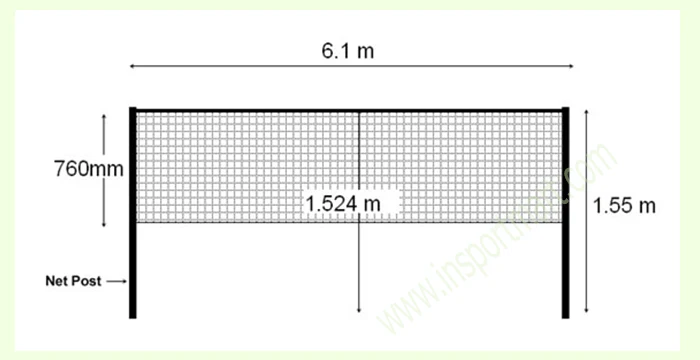
- At the center of the court, the net must measure 5 feet (1.524 meters) in height.
- At the edges, where the net posts are positioned, the height increases slightly to 5 feet 1 inch (1.55 meters).
This slight variation in height between the center and edges ensures proper tension and alignment, preventing sagging and maintaining the net’s integrity throughout the game.
Net Material and Design
The badminton net is crafted with functionality and durability in mind. Its design and materials ensure it withstands the demands of fast-paced play while remaining light enough to avoid interfering with shuttle movement.
- Material:
- The net is typically made from high-quality nylon or polyester. These materials are preferred for their strength, flexibility, and resistance to wear and tear.
- The netting consists of fine threads woven into square mesh patterns with a uniform size of 15-20 mm per side, allowing shuttles to pass through easily without obstruction when they hit the net.
- Top Band:
- The upper edge of the net is reinforced with a white tape or cord, usually 3 inches (75 mm) wide. This band ensures visibility and holds the tensioned cord that secures the net in place.
- Side Posts:
- The net is supported by sturdy posts positioned at the edges of the court. These posts ensure the height remains consistent and the net stays taut during the match.
- The posts should be placed precisely on the doubles sidelines to accommodate all gameplay formats.
Significance of a Well-Made Net in Gameplay
The net is more than just a boundary; it directly impacts the quality and fairness of a badminton match:
- Challenge and Strategy:
- The net’s height challenges players to execute skillful shots, such as net kills or deceptive drops, requiring precision and focus.
- Fairness:
- Consistent tension and optimal height ensure that neither side receives an unfair advantage, maintaining the integrity of the game.
- Safety and Maintenance:
- High-quality materials reduce the likelihood of the net tearing during play, ensuring seamless matches and minimizing interruptions.
Whether you’re preparing for a casual game or an international championship, ensuring adherence to the net’s official specifications is essential. A properly installed and well-maintained net not only enhances the competitive spirit of badminton but also upholds the sport’s standards for professionalism and fairness.
Markings and Lines on a Badminton Court
The markings and lines on a badminton court are fundamental to the structure and flow of the game. Each line has a specific role, defining the areas for serving and playing while ensuring fairness in every match. Whether for singles or doubles, understanding the layout and purpose of these lines is crucial for players and coaches alike. Here’s a detailed look at the essential markings and their functions.
Boundary Lines
The boundary lines outline the playing area of the court. Their dimensions differ for singles and doubles play:
- Singles Boundary Lines:
- The sidelines for singles are drawn closer to the center of the court, narrowing the playing area to 17 feet (5.18 meters) wide.
- Shots that land outside these lines during a singles match are out of bounds.
- Doubles Boundary Lines:
- The doubles court uses the full width of 20 feet (6.1 meters). This expanded area supports the greater movement and coordination needed for doubles play.
- The end boundary line remains the same for both singles and doubles.
These lines are typically marked in white or yellow and measure about 1.5 inches (40 mm) thick for visibility.
Center Line
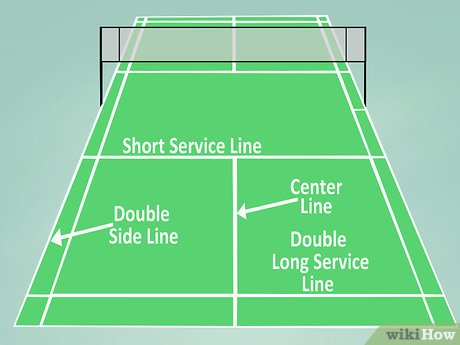
The center line divides the court into left and right service courts on each side of the net. It extends from the back boundary line to the short service line.
Purpose:
- Used during service, the center line helps players identify the correct service court based on their score.
- It ensures that serves are directed into the appropriate half of the opponent’s court, promoting fairness and structure during play.
Short Service Line
The short service line is drawn parallel to the net at a distance of 6 feet 6 inches (1.98 meters) from it. This line plays a critical role in both singles and doubles play.
Purpose:
- Defines the minimum distance a shuttle must travel to be a valid serve.
- Prevents players from serving too close to the net, encouraging more strategic and skillful serves.
Long Service Line
The long service line determines the maximum service distance for players. Its position varies between singles and doubles:
- Singles:
- The back boundary line serves as the long service line, utilizing the full length of the court.
- Players must ensure their serves land within this extended area.
- Doubles:
- The long service line is positioned closer to the net, at 13 feet (3.96 meters) from the back boundary line.
- This shorter service distance encourages quicker rallies and tighter gameplay.
Common Features of the Lines
- All court markings are part of the area they enclose. For example, if a shuttle lands on the boundary line, it is considered in-bounds.
- The lines ensure clarity and enforce rules during matches, creating a structured and consistent playing environment for all players.
Markings in Singles vs. Doubles
The primary differences in markings between singles and doubles lie in the use of boundary lines and the placement of the long service line. Singles focus on a narrower and longer court, favoring precision and endurance. Doubles, on the other hand, benefit from a wider court that prioritizes teamwork and lateral movement.
By understanding the purpose of each line, players can better strategize during matches, adapting their gameplay to the nuances of the court. These carefully designed markings form the backbone of badminton, ensuring fairness and enhancing the level of competition.
Indoor vs Outdoor Court Considerations
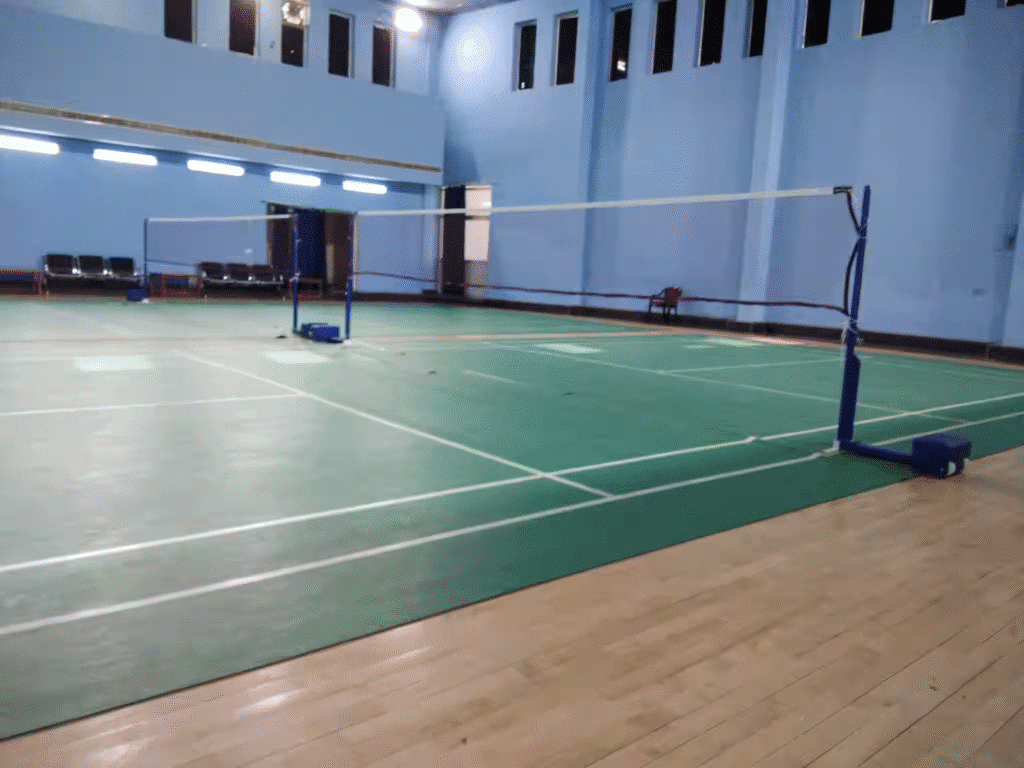
Badminton can be played either indoors or outdoors, but the type of court chosen significantly impacts the gameplay experience. Differences in setup, surface materials, and environmental factors create unique challenges and benefits for each. Here’s a closer look at these considerations to help you understand the distinctions and decide which environment suits your needs.
Setup Differences
- Indoor Courts:
- Typically built to meet official standards, indoor courts are often located in gyms or sports complexes.
- They are marked on smooth, even surfaces such as wooden flooring, synthetic mats, or PVC vinyl.
- Equipped with a controlled setting, these courts maintain consistent lighting and regulated temperatures.
- Outdoor Courts:
- Outdoor courts are more flexible in terms of location, often set up in parks, backyards, or open spaces.
- Lines are usually painted or demarcated on surfaces like asphalt, concrete, or even grass.
- Portable net setups are commonly used for outdoor courts, enabling easy assembly and disassembly.
Surface Materials
- Indoor Surfaces:
- Designed for optimal shock absorption, indoor courts reduce strain on players’ joints during high-impact movements.
- Wooden floors are common due to their flexibility and durability, while synthetic surfaces are chosen for their anti-slip properties.
- The even surface minimizes irregular bounces and enhances control over shuttle placement.
- Outdoor Surfaces:
- Outdoor courts often lack shock-absorbing materials, which can make extended play more fatiguing.
- Surfaces like concrete and asphalt are rougher, causing quicker wear and tear on shuttlecocks and shoes.
- Uneven spots or debris on outdoor courts can disrupt gameplay and increase the risk of injuries.
Environmental Factors
- Wind:
- Indoor Courts:
- Wind is generally not a concern in indoor environments, allowing precise control of shuttle trajectory.
- Outdoor Courts:
- Wind significantly affects play, making shuttle movement unpredictable and challenging for players to manage.
- Players often need to adapt their technique, emphasizing power and trajectory adjustments.
- Indoor Courts:
- Lighting:
- Indoor Courts:
- Indoor courts benefit from consistent and strategically positioned lighting, reducing glare and shadows.
- Outdoor Courts:
- Natural light can vary greatly, with intense sunlight or cloud cover affecting visibility.
- Shadows and changing light conditions can obscure shuttle movement, making gameplay less predictable.
- Indoor Courts:
Pros and Cons
- Indoor Courts:
- Pros:
- Controlled environment ensures a consistent playing experience.
- Professional-grade surfaces enhance safety and performance.
- No interference from weather or wind.
- Cons:
- Access may be limited to specific facilities.
- Setting up or renting indoor play spaces can be costly.
- Pros:
- Outdoor Courts:
- Pros:
- Flexible and accessible in parks or personal spaces.
- Encourages casual, recreational play in open settings.
- Minimal cost for location use, often free.
- Cons:
- Susceptible to unpredictable weather, including wind and rain.
- Uneven surfaces can pose safety risks and disrupt gameplay.
- Equipment, such as nets, may need to be portable and less durable.
- Pros:
Choosing the Right Court
Deciding between indoor and outdoor courts depends on factors like your playing goals, budget, and environmental preferences. Indoor courts offer a professional setup ideal for serious players, while outdoor courts bring flexibility and fun to casual matches. Regardless of the setting, being aware of these considerations ensures that you can enjoy a rewarding badminton experience!
Tips for Setting Up a Shuttle Court
Setting up a shuttle court demands attention to detail to ensure an optimal playing experience and compliance with official standards. Whether for professional matches or casual games, the following tips will help you measure, mark, and prepare a badminton court accurately. Avoiding common setup mistakes will also save you time and effort.
1. Measure the Court Accurately
The first step in creating a shuttle court is taking precise measurements. Use reliable tools like measuring tapes and chalk line markers to map out the playing area. Follow these dimensions as per Badminton World Federation (BWF) regulations:
- Court Size:
- Singles: 44 feet (13.4 meters) long and 17 feet (5.18 meters) wide.
- Doubles: 44 feet (13.4 meters) long and 20 feet (6.1 meters) wide.
- Service Lines:
- Start by marking the center line, short service line (6 feet 6 inches or 1.98 meters from the net), and long service lines.
- Ensure lines are straight and extend fully across the court.
Tip: Use a laser level if available to ensure proper alignment during measurement. For accuracy, double-check dimensions before marking.
2. Marking the Lines
The court lines define playable boundaries and must be clear and visible:
- Use white or yellow chalk, tape, or paint that stands out against the court’s surface.
- Ensure lines are 1.5 inches (40 mm) thick for consistency.
- Allow lines to dry completely if using paint to avoid smudging.
- Check if local regulations require non-slip or eco-friendly materials for markings.
Tip: Regularly inspect and refresh court markings, especially on outdoor surfaces where wear and tear occur more quickly.
3. Choosing the Right Surface
The choice of surface directly impacts player safety and game dynamics. Evaluate the location and type of play to select the best option:
- Indoor Courts:
- Opt for wooden flooring or synthetic materials like PVC, which provide shock absorption and anti-slip properties.
- Outdoor Courts:
- Choose durable surfaces like asphalt or concrete for ease of maintenance. Grass may be suitable for informal games but isn’t ideal for professional play due to unevenness and lack of bounce consistency.
Tip: Level the court before marking it. Irregularities in the surface can cause unpredictable shuttle movement and increase the risk of injuries.
4. Install the Net Properly
The net setup is equally critical in creating a functional shuttle court. Improper net installation can lead to uneven play or disputes:
- Use sturdy posts placed on the doubles sideline to support the net.
- Set the net height at 5 feet (1.524 meters) at the center and 5 feet 1 inch (1.55 meters) at the edges.
- Ensure proper tension in the net to prevent sagging. Use tie-down cords or brackets to secure it firmly.
Tip: Adjust the net regularly before matches to maintain the correct height, especially if the court is used frequently.
5. Common Mistakes to Avoid
Even small missteps can impact the court’s quality and usability. Avoid these frequent mistakes:
- Wrong Measurements:
Neglecting precise measurement or marking boundaries incorrectly can lead to disputes during gameplay.
- Uneven or Worn Surfaces:
Playing on an unprepared or damaged surface increases safety concerns and diminishes the quality of the game.
- Poor Visibility of Markings:
Faint or irregular lines may confuse players, so use durable and easily visible materials.
- Loose Nets:
An improperly tensioned net can disrupt gameplay and require constant adjustments.
Final Thoughts
Setting up a shuttle court with precision ensures fair play and an enjoyable experience for everyone involved. By following these tips and prioritizing accurate measurements, visible markings, proper surfaces, and a well-set net, you can create a professional-grade badminton court. Avoid common errors, and you’ll have a setup ready to support some thrilling matches!
Fun Facts About Shuttle Court Measurements
Badminton might seem like a straightforward game, but there are plenty of quirky and surprising stories behind its standard court dimensions. From historical curiosities to evolution-driven tweaks, the measurements of a shuttle court hold more intrigue than you might expect. Here’s a collection of fun facts to brighten your shuttlecock skills!
1. The Origins That Stretch Back to the 19th Century
Did you know that badminton’s modern court dimensions have their roots in a game called Poona, played in India during British colonial times? British officers stationed in India brought the game to their homeland in the 1800s, eventually shaping it into the badminton we know today. Back then, courts were informal, often drawn on lawns, and their exact size varied depending on the space players had.
2. The Doubles Court “T”-Shaped Legacy
Ever wondered why the doubles court has a distinct “T” pattern with a shorter service area? This unique feature owes its origins to the geometry of early designs, which evolved to create the fast-paced, team-oriented gameplay we now enjoy. The tighter service box in doubles was meant to make serves more challenging—and it still keeps doubles matches exciting today!
3. How Court Dimensions Became Official
Over time, as badminton began flourishing as a competitive sport, agreeing on a standardized court became critical. The International Badminton Federation (renamed the Badminton World Federation (BWF)) stepped in during the early 20th century. The dimensions we follow today—44 feet long and 20 feet wide for doubles—were formalized to ensure uniformity across the growing number of tournaments.
4. The Surprising Role of Subtle Symmetry
Badminton courts are symmetrical so neither player has an advantage, but there’s more precision here than meets the eye. For example, the net is slightly higher at the sides than the center, ensuring even tension and avoiding game-altering sagging in the middle. This tiny adjustment—just a 1-inch difference—may seem minor, but it has a noticeable impact during competitive matches.
5. Smaller Courts for Younger Beginners
Junior badminton players often start on scaled-down courts! To help young players develop their skills, they use shorter rackets, lower nets, and tighter playing spaces, encouraging accuracy and reducing the intimidation of larger courts. It’s badminton, child-sized!
6. Grassroots Courts Show Innovation
Not all shuttle courts around the world are built to BWF standards, leading to some charming local adaptations. In some communities, badminton courts are drawn on sandy beaches, concrete courtyards, and even rooftops. These improvised settings show just how adaptable badminton can be—and highlight its global appeal.
7. The Metrics Behind Line Thickness
Those bold white lines on the court? They’re not arbitrary. At 1.5 inches thick, the lines meet specific BWF rules to remain visible yet non-intrusive. Any deviation in thickness could unfairly influence a line-call judgment! They’re the unsung heroes ensuring disputes are kept to a minimum.
8. It’s Not Just Any 44 Feet
The court’s length doesn’t just exist for practical reasons—it also influences strategy. If the court were even a foot shorter or longer, the dynamic of the game would shift dramatically. Players’ ability to rely on deep clears or bring out cross-court smashes hinges entirely on keeping that precise 44-foot length.
9. Not Always Rectangular
Quick trivia—did you know early methods of badminton in the late 1800s were often improvised for convenience? Courts were sometimes shaped as hourglasses or irregular spaces based purely on what lawns or gardens could offer. The rectangle we’ve adopted today only cemented itself as the sport became more competitive.
10. The Fastest Game Needs Precision
Finally, consider this—the fastest recorded shuttlecock smash clocks in at over 332 km/h (206 mph)! At those speeds, court measurements and markings need to be spot-on; otherwise, the finesse and integrity of the spectacle would falter. Talk about a game reliant on split-second accuracy!
Final Thought
Badminton courts may look simple at first glance, but their dimensions are steeped in history, innovation, and a keen eye for detail. Next time you step onto the court, take a moment to appreciate the fascinating story those white lines and measurements have to tell!