
Understanding the tennis court size is essential for players, coaches, builders, schools, and sports academies. Whether you are learning the game or planning to construct a professional tennis court, following the official court dimensions ensures fair play, safety, and tournament compliance.
This guide explains tennis court measurements, line markings, net height, total area, and layout standards as approved by the International Tennis Federation (ITF).
What Is the Standard Tennis Court Size?
A tennis court is a rectangular playing area divided by a net in the center. The court size remains the same worldwide, whether for professional tournaments, clubs, or training facilities.
Official Tennis Court Dimensions (ITF)
| Court Type | Length | Width |
|---|---|---|
| Singles Court | 23.77 m (78 ft) | 8.23 m (27 ft) |
| Doubles Court | 23.77 m (78 ft) | 10.97 m (36 ft) |
➡️ The length remains the same for singles and doubles; only the width changes.
Official Tennis Court Dimensions
The official dimensions of a tennis court, as defined by the International Tennis Federation (ITF), are as follows:
Court Dimensions
- Length: 78 feet (23.77 meters)
- Width:
- Singles: 27 feet (8.23 meters)
- Doubles: 36 feet (10.97 meters)
Service Boxes
- Each service box is 21 feet (6.4 meters) long and 13.5 feet (4.11 meters) wide.
Net
- Height at the center: 3 feet (0.91 meters)
- Height at the posts: 3.5 feet (1.07 meters)
Additional Areas
- Doubles Alleys: 4.5 feet (1.37 meters) wide on each side of the singles court.
- Baseline to Back Fence: A recommended minimum of 21 feet (6.4 meters) for player movement.
- Sideline to Side Fence: A recommended minimum of 12 feet (3.66 meters) for player movement.
These dimensions are used for professional and recreational play worldwide.
Tennis Court Size: Singles vs Doubles
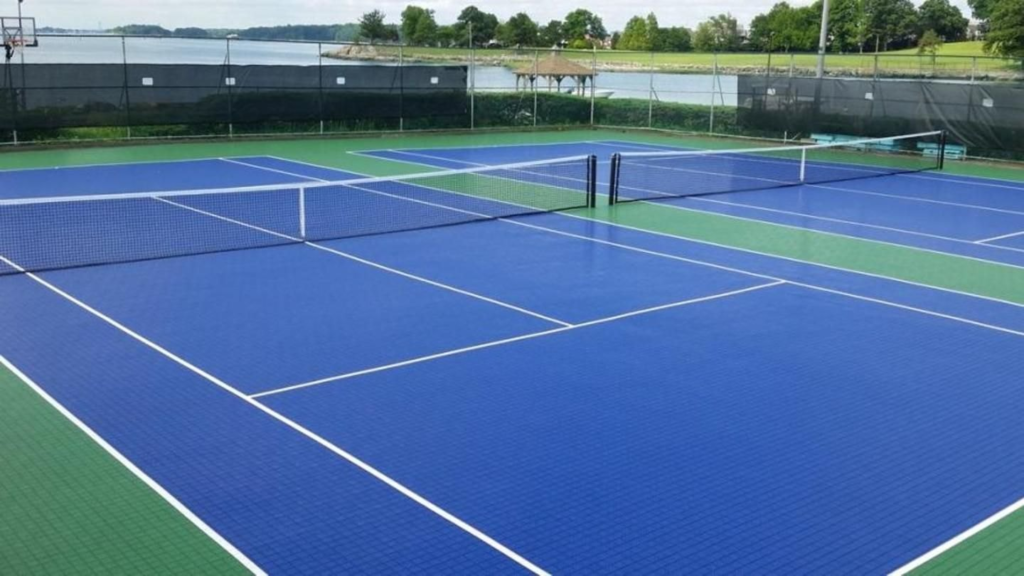
The size of a tennis court differs slightly between singles and doubles play due to the inclusion of the doubles alleys. Here’s a breakdown:
Singles Court Dimensions
- Length: 78 feet (23.77 meters)
- Width: 27 feet (8.23 meters)
Doubles Court Dimensions
- Length: 78 feet (23.77 meters) (same as singles)
- Width: 36 feet (10.97 meters)
Key Difference
- The doubles court includes the doubles alleys, which are 4.5 feet (1.37 meters) wide on each side of the singles court. These alleys are not used in singles play.
Other Shared Dimensions
- Service Boxes: 21 feet (6.4 meters) long and 13.5 feet (4.11 meters) wide.
- Net Height: 3 feet (0.91 meters) at the center and 3.5 feet (1.07 meters) at the posts.
In summary, the main difference is the width: singles courts are narrower, while doubles courts include the alleys for additional playing area.
Total Tennis Court Area (Including Run-Off Space)
The total area of a tennis court, including the recommended run-off space for safe play, depends on the guidelines set by the International Tennis Federation (ITF). Here’s the breakdown:
Standard Court Dimensions (Playing Area Only)
- Singles Court: 78 feet (23.77 meters) x 27 feet (8.23 meters) = 2,106 square feet (195.7 square meters)
- Doubles Court: 78 feet (23.77 meters) x 36 feet (10.97 meters) = 2,808 square feet (260.9 square meters)
Total Area with Run-Off Space
The ITF recommends additional space around the court for player movement and safety:
- Behind the Baseline: 21 feet (6.4 meters) on each side
- Beyond the Sidelines: 12 feet (3.66 meters) on each side
This results in a total area of:
- Length: 78 feet + (21 feet x 2) = 120 feet (36.58 meters)
- Width: 36 feet + (12 feet x 2) = 60 feet (18.29 meters)
Total Court Area (Including Run-Off)
- 120 feet x 60 feet = 7,200 square feet (668.9 square meters)
This is the standard size for a full tennis court with adequate run-off space, suitable for both singles and doubles play.
Tennis Court Line Markings Explained
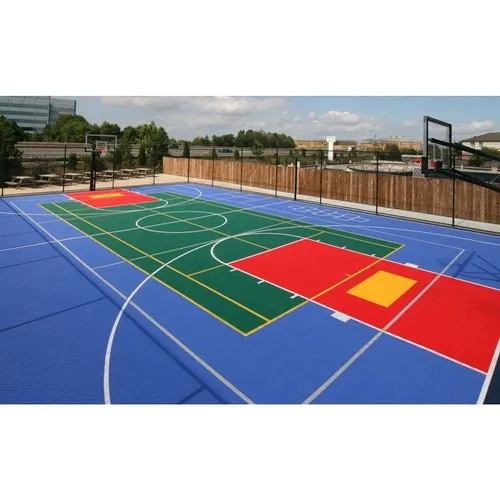
Tennis court line markings are essential for defining the boundaries and areas of play. Here’s a breakdown of the key lines and their purposes:
1. Baseline
- Location: The lines at the far ends of the court, parallel to the net.
- Purpose: Marks the boundary for the length of the court. Players serve from behind this line.
2. Singles Sidelines
- Location: The inner lines running lengthwise on the court.
- Purpose: Define the width of the court for singles matches (27 feet wide).
3. Doubles Sidelines
- Location: The outermost lines running lengthwise on the court.
- Purpose: Define the width of the court for doubles matches (36 feet wide).
4. Service Line
- Location: Parallel to the net, halfway between the net and the baseline.
- Purpose: Divides the court into the service boxes. Serves must land within the service box on the opponent’s side.
5. Center Service Line
- Location: Perpendicular to the net, running from the net to the service line.
- Purpose: Divides the service boxes into left and right sections.
6. Center Mark
- Location: A small line in the middle of the baseline.
- Purpose: Helps players position themselves when serving.
7. Net
- Location: Divides the court into two equal halves.
- Height: 3 feet (0.91 meters) at the center and 3.5 feet (1.07 meters) at the posts.
Service Boxes
- Dimensions: Each box is 21 feet (6.4 meters) long and 13.5 feet (4.11 meters) wide.
- Purpose: Serves must land in the diagonally opposite service box.
Doubles Alleys
- Width: 4.5 feet (1.37 meters) on each side of the singles court.
- Purpose: Used only in doubles matches to extend the width of the court.
Tennis Net Height & Post Measurements
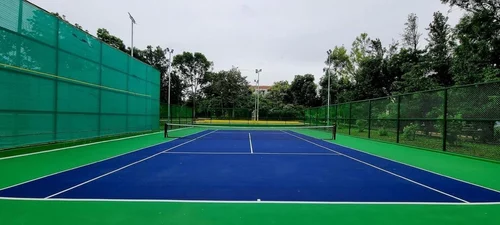
The tennis net and its posts are crucial components of the court, and their dimensions are regulated by the International Tennis Federation (ITF). Here’s a detailed breakdown:
Net Height
- At the Center: 3 feet (0.91 meters)
- At the Posts: 3.5 feet (1.07 meters)
The net is slightly lower in the middle due to the tension created by the center strap.
Net Posts
- Height: 3.5 feet (1.07 meters) to match the net’s height at the posts.
- Distance from the Sidelines:
- For Singles: Posts are placed 3 feet (0.914 meters) outside the singles sidelines.
- For Doubles: Posts are placed 3 feet (0.914 meters) outside the doubles sidelines.
Net Width
- The net spans the full width of the court:
- Singles: 27 feet (8.23 meters)
- Doubles: 36 feet (10.97 meters)
Net Strap and Band
- Center Strap: Keeps the net at the correct height in the middle (3 feet).
- White Band: The top of the net is covered with a white band, typically 2-2.5 inches (5-6.35 cm) wide, to improve visibility and durability.
Minimum Space Required to Build a Tennis Court
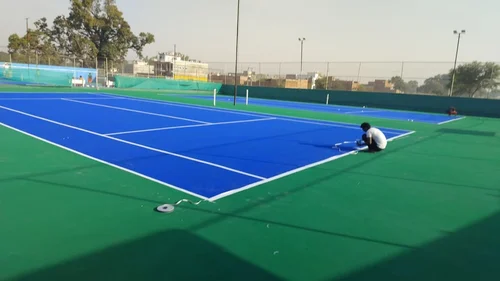
To build a tennis court, you need to account for the playing area as well as the surrounding run-off space for player safety and movement. The minimum space required depends on whether the court is for recreational or professional use.
Minimum Space for a Tennis Court
- Length: 120 feet (36.58 meters)
- Width: 60 feet (18.29 meters)
- Total Area: 7,200 square feet (668.9 square meters)
This includes:
- Playing Area: 78 feet (23.77 meters) x 36 feet (10.97 meters) for doubles.
- Run-Off Space:
- Behind the Baselines: 21 feet (6.4 meters) on each side.
- Beyond the Sidelines: 12 feet (3.66 meters) on each side.
Recommended Space for Professional Courts
For tournaments or high-level play, additional space is often recommended:
- Length: 132 feet (40.23 meters)
- Width: 66 feet (20.12 meters)
- Total Area: 8,712 square feet (809.4 square meters)
This provides more room for spectators, officials, and additional equipment.
Additional Considerations
- Surface Type: Grass, clay, or hard court surfaces may require specific preparation and drainage systems.
- Fencing: Courts are typically enclosed with fencing, which requires extra space around the perimeter.
- Lighting: If the court will be used at night, ensure space for light poles.
By following these guidelines, you can ensure a safe and functional tennis court for players of all levels.
Tennis Court Size for Different Surfaces
The size of a tennis court remains standard across all surface types (grass, clay, hard court, or artificial turf) as regulated by the International Tennis Federation (ITF). However, the preparation and maintenance of the court may vary depending on the surface. Here’s a breakdown:
Standard Tennis Court Dimensions (All Surfaces)
- Length: 78 feet (23.77 meters)
- Width:
- Singles: 27 feet (8.23 meters)
- Doubles: 36 feet (10.97 meters)
- Service Boxes: 21 feet (6.4 meters) long and 13.5 feet (4.11 meters) wide.
- Net Height:
- Center: 3 feet (0.91 meters)
- Posts: 3.5 feet (1.07 meters)
Run-Off Space
The total area required for a court, including run-off space, is the same regardless of the surface:
- Minimum Space: 120 feet (36.58 meters) x 60 feet (18.29 meters) = 7,200 square feet (668.9 square meters).
- Recommended for Professional Play: 132 feet (40.23 meters) x 66 feet (20.12 meters) = 8,712 square feet (809.4 square meters).
Surface-Specific Considerations
- Grass Courts:
- Require precise leveling and regular mowing.
- Drainage systems are essential to prevent waterlogging.
- Often used in prestigious tournaments like Wimbledon.
- Clay Courts:
- Made of crushed brick, shale, or stone.
- Require frequent watering and rolling to maintain a smooth surface.
- Common in Europe and South America.
- Hard Courts:
- Made of asphalt or concrete with an acrylic top layer.
- Low maintenance compared to grass or clay.
- Used in tournaments like the US Open and Australian Open.
- Artificial Turf:
- Synthetic grass with sand infill.
- Low maintenance and suitable for recreational use.
Common Mistakes in Tennis Court Measurements
When constructing or marking a tennis court, even small errors in measurements can lead to issues with playability and compliance with regulations. Here are some common mistakes to watch out for:
1. Incorrect Court Dimensions
- Mixing Singles and Doubles Widths: Forgetting to account for the doubles alleys (4.5 feet wide on each side) when marking a doubles court.
- Wrong Length: The court must always be 78 feet long, regardless of singles or doubles play.
2. Improper Net Height
- Center Height: The net should be exactly 3 feet (0.91 meters) at the center, maintained by a center strap.
- Post Height: The net posts should be 3.5 feet (1.07 meters) high, ensuring proper tension.
3. Misaligned Lines
- Service Boxes: The center service line and service line must divide the service boxes into equal halves. Uneven service boxes can disrupt play.
- Center Mark: The center mark on the baseline should be exactly 4 inches (10 cm) long and centered.
4. Insufficient Run-Off Space
- Behind Baselines: A minimum of 21 feet (6.4 meters) is required for safe player movement.
- Beyond Sidelines: A minimum of 12 feet (3.66 meters) is needed on each side.
- Mistake: Skimping on run-off space can make the court unsafe, especially for competitive play.
5. Overlooking Line Width
- Regulation Line Width: All court lines must be between 1 inch (2.54 cm) and 2 inches (5 cm) wide, except the baseline, which can be up to 4 inches (10 cm) wide.
- Mistake: Inconsistent line widths can confuse players and lead to disputes.
6. Incorrect Net Post Placement
- Singles Court: Posts should be 3 feet (0.914 meters) outside the singles sidelines.
- Doubles Court: Posts should be 3 feet (0.914 meters) outside the doubles sidelines.
- Mistake: Placing posts too close or too far can affect net tension and playability.
7. Ignoring Surface Slope
- Mistake: Failing to create a slight slope for drainage (especially on hard or clay courts) can lead to water pooling and damage.
8. Neglecting Orientation
- Mistake: Courts should ideally be oriented north-south to minimize sun glare during play. East-west orientation can cause visibility issues.
9. Inconsistent Measurements
- Mistake: Using inaccurate tools or not double-checking measurements can lead to uneven or non-regulation courts.
10. Forgetting Maintenance Needs
- Grass and Clay Courts: Not accounting for the space needed for maintenance equipment or drainage systems.
Conclusion
Knowing the correct tennis court size is crucial for proper gameplay, construction accuracy, and professional standards. Whether you are building a court for a school, academy, or private property, following official ITF measurements ensures safety, durability, and international compliance.
FAQ’s
What is the standard tennis court size?
The standard tennis court size is 23.77 meters (78 feet) long. The width is 8.23 meters (27 feet) for singles and 10.97 meters (36 feet) for doubles.
Is the tennis court length the same for singles and doubles?
Yes, the length remains the same for both singles and doubles matches. Only the court width changes.
How much total space is required to build a tennis court?
Including run-off space, a tennis court requires approximately 668 to 690 square meters of land for safe play.
Does tennis court size change with surface type?
No, the court dimensions remain the same for all surfaces such as acrylic, clay, grass, synthetic, and hard courts.
What is the width difference between singles and doubles courts?
A doubles court is 1.37 meters (4.5 feet) wider on each side than a singles court.