
Tennis court flooring in Rajasthan plays a vital role in building durable, high-performance courts suited to the state’s arid climate, extreme heat, and dust conditions. Whether you’re constructing a new court for a school, club, residential property, or public facility, choosing the right surface type, material, and installation method ensures optimal playability, safety, and long-term value.
What Is Tennis Court Flooring?
Tennis court flooring in Rajasthan refers to the surface material and structure on which tennis is played. The flooring affects:
- Ball bounce and speed
- Player movement and traction
- Shock absorption
- Durability and maintenance needs
The right flooring enhances player performance and reduces injuries.
Why Flooring Choice Matters in Rajasthan
Tennis court flooring in Rajasthan must withstand harsh environmental factors:
- High temperatures (40°C+)
- Low humidity
- Wind-blown sand and dust
- Intense UV exposure
These conditions can accelerate wear on weak surfaces. A robust flooring solution improves longevity and play experience.
Top Tennis Court Flooring Types
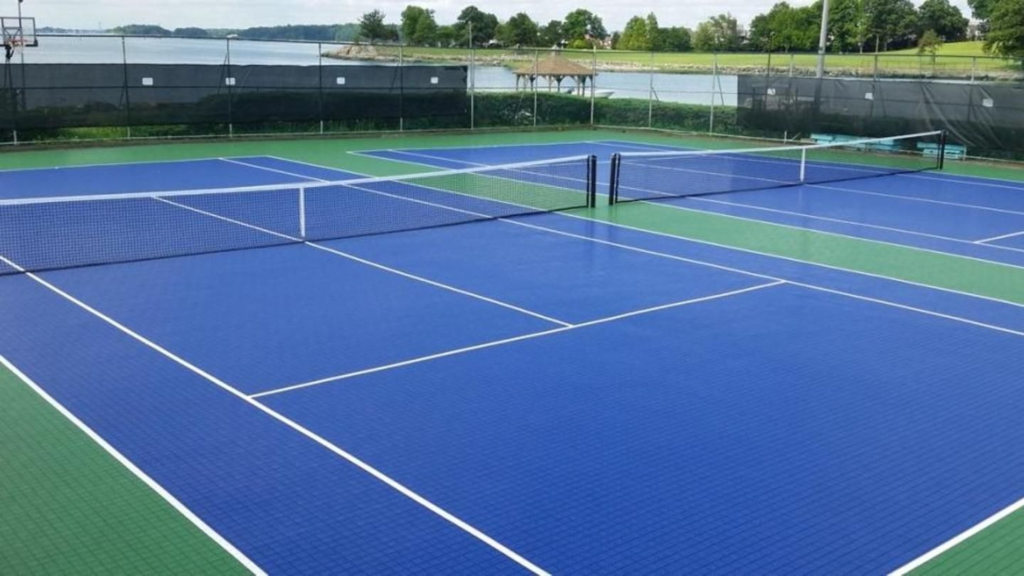
3.1 Hard Courts (Asphalt or Concrete with Acrylic Finish)
Tennis court flooring in Rajasthan most commonly uses hard courts.
Characteristics:
- Durable and low-maintenance
- Consistent ball bounce
- Best for all-round play
Pros:
- Withstands heat and dust
- Affordable long-term maintenance
- Ideal for schools, academies, clubs
Cons:
- Can be hard on joints if not properly cushioned
Best Finish: Multi-layer acrylic paint with textured topcoat
3.2 Synthetic Turf
Tennis court flooring in Rajasthan may use synthetic turf for softer cushion.
Characteristics:
- Grass-like feel
- Good shock absorption
Pros:
- Comfortable underfoot
- Cooler surface in hot sun
Cons:
- Higher installation cost
- Regular brushing needed
Best For: Residential courts or recreational facilities
3.3 Clay Courts
Tennis court flooring in Rajasthan clay courts are less common due to high maintenance but remain preferred for slow, strategic play.
Characteristics:
- Loose particles (red/green clay)
Pros:
- Slower ball speed
- Gentle on knees
Cons:
- Not ideal in dusty, dry climate
- Frequent watering and rolling required
Best For: Traditional tennis facilities with adequate water
3.4 Artificial Clay & Rubberized Surfaces
Tennis court flooring in Rajasthan now includes hybrid options that combine clay feel with better resilience.
Characteristics:
- Consistent bounce
- Some cushioning
Pros:
- Lower maintenance versus real clay
- Suitable for schools and clubs
Cons:
- Moderate cost
Flooring Specifications & Dimensions
Tennis court flooring in Rajasthan must conform to International Tennis Federation (ITF) standards:
| Feature | Standard |
|---|---|
| Court Length | 23.77 m |
| Court Width (Singles) | 8.23 m |
| Court Width (Doubles) | 10.97 m |
| Surface Flatness | Minimal deviation |
| Perimeter Drainage | Required |
Sealing and proper drainage are crucial in extreme weather.
Installation Process (Step-by-Step)
🔹 Site Preparation
- Clear & level ground
- Soil compaction
- Sub-base grading for water flow
🔹 Base Construction
- Concrete or asphalt slab
- Minimum thickness (~100–150 mm)
- Expansion joints for heat cycles
🔹 Surface Application
- Primer
- Multiple acrylic layers
- Texture finish for grip
🔹 Line Marking
- UV-resistant paint
- Regulation width and color contrast
🔹 Optional Features
- Shock pads
- Perimeter fencing
- Net posts & anchoring
Proper curing times and dust-free conditions ensure surface integrity.
Cost Factors in Rajasthan
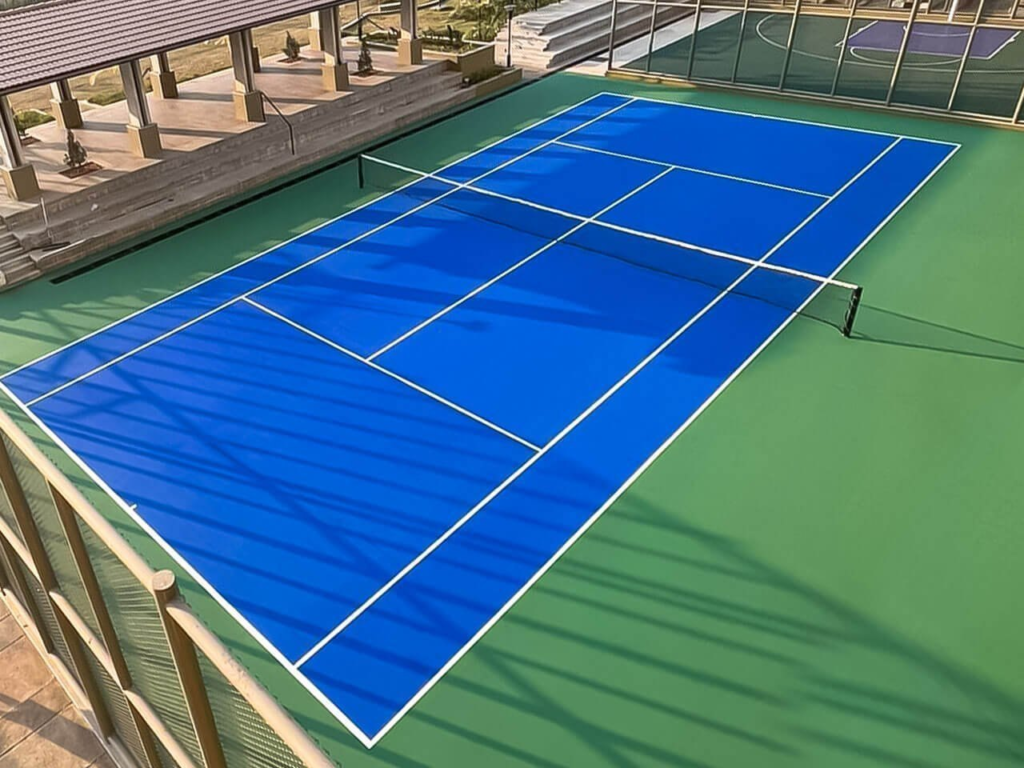
Tennis court flooring in Rajasthan pricing depends on:
- Flooring type (hard vs turf vs hybrid)
- Site access and leveling needs
- Sub-base quality
- Drainage systems
- Accessories (nets, fencing, lighting)
Typical Range (Indicative):
- Hard court: ₹15–₹30+ lakh
- Synthetic turf: ₹20–₹40+ lakh
- Hybrid/advanced finishes: ₹25–₹45+ lakh
Prices vary by contractor, materials, and site specifics.
Maintenance Tips for Rajasthan Climates
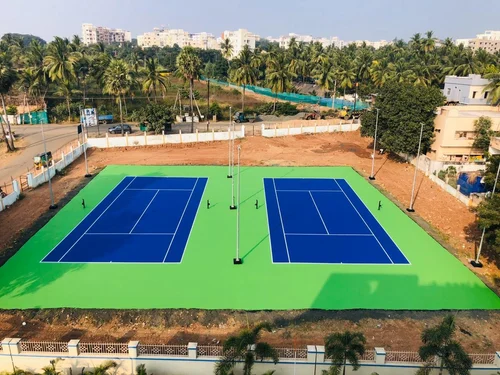
Tennis court flooring in Rajasthan needs regular care to resist weathering and preserve performance:
Daily / Weekly
- Sweep dust and debris
- Check net tension
Monthly
- Inspect surface for cracks
- Clean lines and textures
Seasonal
- Repaint surface every 3–5 years
- Refill textured topcoats if needed
Avoid water pooling after monsoon; ensure drainage is functioning.
Choosing the Right Contractor
To deliver top-quality tennis court flooring in Rajasthan, select professionals who offer:
✔ ITF/ASTM standards compliance
✔ Waterproofing & UV protection expertise
✔ Warranty on materials & workmanship
✔ Local experience with Rajasthan’s climate
Ask for past project photos, client references, and detailed quotes.
FAQs
What is the best tennis court flooring in Rajasthan?
Tennis court flooring in Rajasthan works best with acrylic hard court surfaces because they tolerate extreme heat, dust, and UV exposure while offering consistent bounce and low maintenance.
Is acrylic tennis court flooring suitable for hot climates?
Tennis court flooring in Rajasthan commonly uses acrylic systems as they are UV-resistant, heat-stable, and do not crack easily when installed with proper expansion joints.
How much does tennis court flooring cost in Rajasthan?
Tennis court flooring in Rajasthan typically costs between ₹15 lakh to ₹45 lakh, depending on surface type, base construction, drainage, and additional features like fencing and lighting.
How long does tennis court flooring last in Rajasthan weather?
Tennis court flooring in Rajasthan can last 8–10 years with proper maintenance, while resurfacing is usually required every 3–5 years for acrylic courts.
Can tennis courts be constructed in desert areas of Rajasthan?
Tennis court flooring in Rajasthan can be successfully installed in desert regions using reinforced concrete bases, dust-resistant coatings, and efficient drainage systems.