
Synthetic tennis court flooring is one of the most popular and durable surface solutions for modern tennis facilities. Whether you are building a new court or resurfacing an existing one, understanding the various types of synthetic surfaces, installation steps, performance differences, and cost considerations is essential for making the right decision.
This in-depth guide covers everything you need to know about synthetic tennis court flooring—from materials and benefits to installation, maintenance, and choosing the best system for your needs.
Table of Contents
What Is Synthetic Tennis Court Flooring?
Synthetic tennis court flooring refers to man-made (non-natural) surface systems designed to provide high performance, weather resistance, consistent bounce, and low maintenance. These systems are engineered for outdoor and indoor use and are commonly used in sports clubs, academies, schools, and residential projects.
Unlike grass or clay courts, synthetic surfaces offer uniform traction and durability, making them ideal for year-round play in varied climates.
Benefits of Synthetic Tennis Court Flooring
1. Durability & Weather Resistance
Synthetic courts withstand sun, rain, and temperature changes without major wear, making them ideal for outdoor environments.
2. Consistent Ball Bounce
Modern synthetic surfaces deliver predictable and uniform ball behavior, improving play quality for all skill levels.
3. Low Maintenance
Compared to grass and clay, synthetic tennis court flooring requires minimal upkeep, reducing annual operating costs.
4. Customizable Performance
Surface texture, cushioning layers, and coatings can be adjusted for speed, comfort, and player preference.
5. Cost-Effective Long Term
While initial investment varies, the lifespan and low maintenance make synthetic surfaces cost-efficient in the long run.
Types of Synthetic Tennis Court Flooring
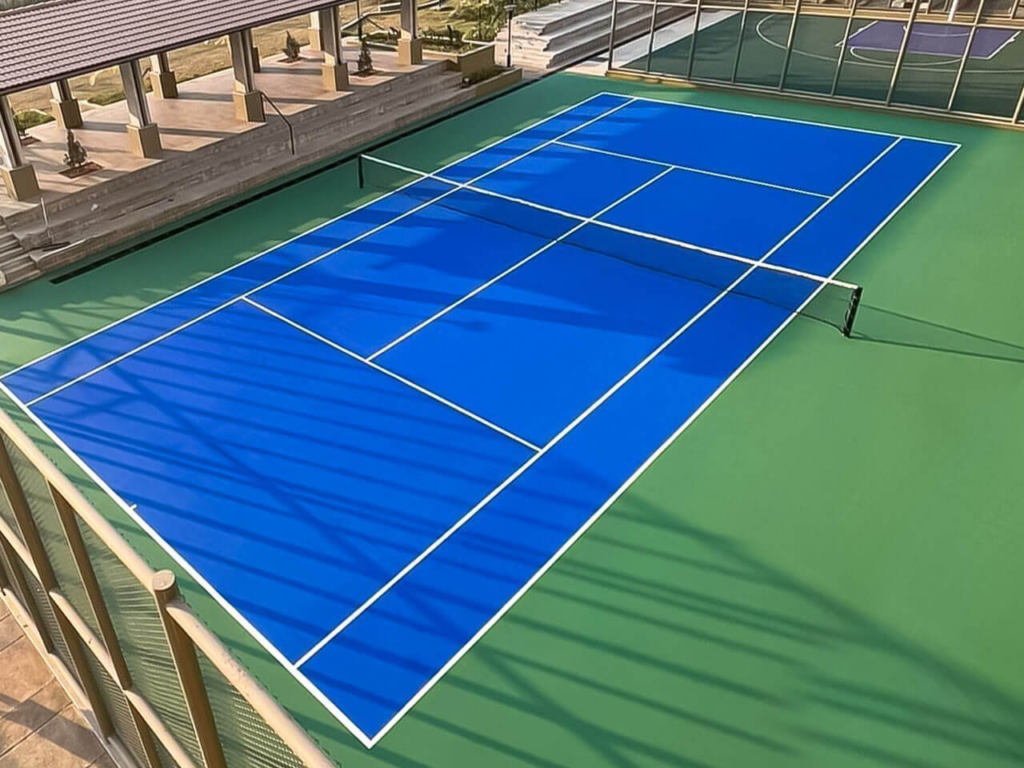
1. Acrylic Tennis Court Surface
This is the most common type of synthetic tennis flooring.
- Made from acrylic resins and UV-resistant coatings
- Multi-layer system applied over concrete or asphalt
- Offers medium to high ball speed
- Excellent weather resistance
Best for: Clubs, schools, public courts
2. Cushioned Acrylic Court Flooring
Cushioned acrylic systems include extra layers that absorb shock and reduce impact on joints.
- Provides enhanced comfort
- Reduces player fatigue
- Ideal for high-usage areas
Best for: Training centers, academies
3. Polyurethane (PU) Tennis Court Flooring
PU systems are seamless and flexible, often preferred for indoor courts.
- Excellent shock absorption
- Good for players with joint concerns
- Can be custom colored
Best for: Indoor courts, multi-purpose halls
4. Synthetic Turf Tennis Court
Artificial grass surfaces fall under synthetic options but are less common for traditional tennis.
- Slower ball speed
- Softer feel
- Often used for recreational play
Best for: Recreational clubs, residential settings
Synthetic Tennis Court Flooring Components
| Layer | Function |
|---|---|
| Base (Concrete/Asphalt) | Structural support |
| Primer | Improves adhesion |
| Cushion Layer (Optional) | Shock absorption |
| Acrylic/PU Surface Coating | Playing surface |
| Line Markings | Game boundaries and measurements |
| UV Protective Coat | Weather resistance and longevity |
Installation Process (Step-by-Step)
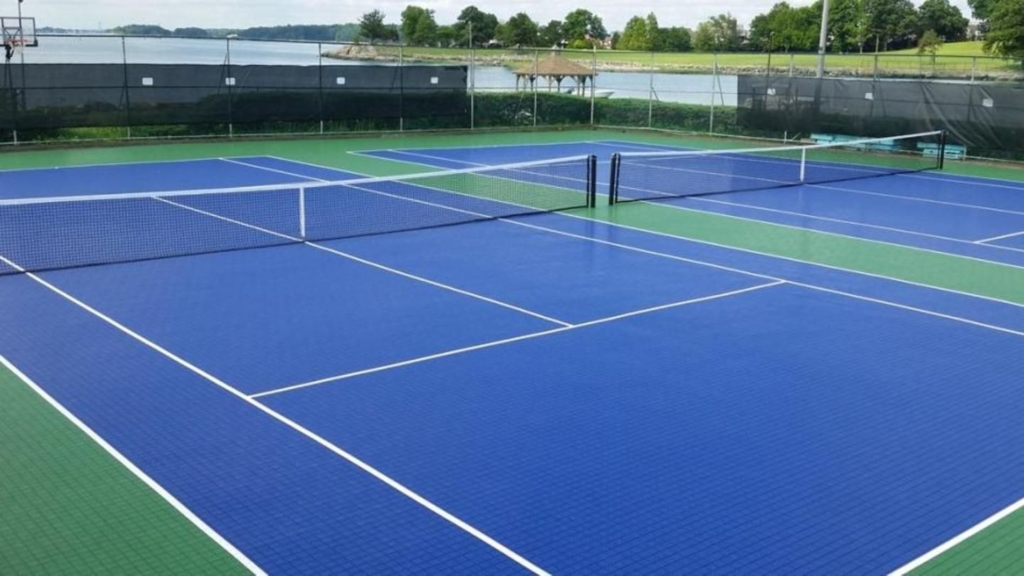
1. Site Preparation
- Clear vegetation and debris
- Level the ground
- Ensure proper drainage
2. Base Construction
- Construct a strong concrete or asphalt base
- Minimum depth and compaction standards must be met
3. Primer Application
- Enhances bonding between base and surface layers
4. Cushion Layer (Optional)
- Rubber or elastomeric compounds mixed with acrylic
- Added for comfort and joint protection
5. Surface Coating
- Multiple acrylic or PU coats applied
- Textured finish for traction
6. Line Marking
- Regulations-compliant line layout
- Durable paint for long life
7. Final Protective Coat
- UV and weather-resistant sealant
Cost of Synthetic Tennis Court Flooring (2026)
| Type | Approx. Cost (₹ / sq. ft.) |
|---|---|
| Standard Acrylic | ₹180 – ₹300 |
| Cushioned Acrylic | ₹280 – ₹450 |
| PU Seamless System | ₹350 – ₹600 |
| Synthetic Turf | ₹250 – ₹500 |
Note: Final costs vary by location, base work, site accessibility, and materials used.
Choosing the Right Surface Type
For Competitive Play
- Standard acrylic or cushioned acrylic
- Consistent ball speed
- Durable finish
For Training & High Usage
- Cushioned acrylic or PU system
- Shock absorption
- Player comfort
For Recreation
- Standard acrylic or synthetic turf
- Lower cost
- Comfortable playing feel
Synthetic Tennis Court Flooring vs Alternatives
| Feature | Synthetic Acrylic | Clay | Grass |
|---|---|---|---|
| Durability | High | Medium | Low |
| Maintenance | Low | High | Very High |
| Weather Resistance | Excellent | Poor | Poor |
| Cost | Moderate | Moderate | High |
| Ball Speed | Medium | Slow | Fast/Irregular |
Maintenance Tips for Synthetic Tennis Courts
- Sweep regularly to remove debris
- Wash surface periodically with mild detergent
- Inspect for cracks and wear
- Recoat acrylic systems every 4–6 years
- Ensure clear drainage paths
Lifespan of Synthetic Tennis Court Flooring
- Standard acrylic: 5–8 years
- Cushioned acrylic: 6–10 years
- PU system (indoor): 8–12 years
Lifespan increases with proper maintenance and recoating schedules.
Color Options & Aesthetics
Modern synthetic systems offer a wide range of color combinations:
- Classic blue/green contrast
- Red or green surfaces
- Custom branding colors
Colors help with visibility, aesthetics, and player experience.
Environmental Considerations
High-quality synthetic systems now often use:
- Water-based coatings
- Low VOC materials
- Recyclable raw materials in some components
These improve eco-friendliness and safety.
Choosing the Right Contractor
When selecting an installer, check for:
- Proven track record in tennis court projects
- Compliance with international standards
- Warranty on materials and workmanship
- After-installation support
- Field references and gallery of past projects
ITF & International Standards for Synthetic Tennis Court Flooring
When constructing a professional or semi-professional tennis court, compliance with international standards is crucial. Synthetic tennis court flooring systems are often designed to meet ITF (International Tennis Federation) guidelines.
ITF Court Pace Ratings
Synthetic courts are classified based on ball speed and surface friction:
- Category 1 – Slow Pace
- Category 2 – Medium-Slow
- Category 3 – Medium
- Category 4 – Medium-Fast
- Category 5 – Fast Pace
Most acrylic synthetic courts fall under Category 2 to Category 4, making them suitable for training, tournaments, and recreational play.
Shock Absorption & Player Safety
One of the biggest advantages of modern synthetic tennis court flooring is player safety.
How Shock Absorption Works
Cushioned systems use:
- Rubber granules
- Elastic binders
- Multi-layer cushioning coats
These layers:
- Reduce impact on knees and ankles
- Lower injury risk
- Improve playing comfort for long sessions
This makes cushioned synthetic flooring ideal for academies and high-use courts.
Drainage & Slope Design for Outdoor Courts
Proper drainage is critical for outdoor synthetic tennis courts.
Recommended Slope
- Ideal slope: 1:100 to 1:120
- Prevents water pooling
- Maintains even ball bounce
Drainage Features
- Peripheral drains
- Proper base compaction
- Water-resistant coatings
Well-designed drainage allows courts to be playable shortly after rain.
Base Quality: The Foundation of Long-Lasting Courts
The base layer determines 90% of court durability.
Concrete Base
- Higher initial cost
- Very stable
- Longer lifespan
- Preferred for permanent facilities
Asphalt Base
- Faster installation
- Lower upfront cost
- Requires periodic resurfacing
- Suitable for budget-controlled projects
A poor base can cause cracks, water seepage, and premature surface failure.
Resurfacing vs New Construction
Many facility owners choose resurfacing instead of rebuilding.
When to Resurface
- Minor surface cracks
- Color fading
- Reduced traction
- Worn line markings
Resurfacing Benefits
- 40–60% lower cost than new construction
- Faster completion (5–7 days)
- Improves aesthetics and playability
Resurfacing can extend court life by 5–7 additional years.
Common Mistakes to Avoid in Synthetic Tennis Court Projects
Avoiding these mistakes can save time and money:
- Choosing low-grade acrylic materials
- Ignoring base slope and drainage
- Skipping primer layers
- Using non-UV-resistant coatings
- Hiring inexperienced installers
Professional planning ensures consistent bounce and long-term durability.
Customization Options for Synthetic Tennis Courts
Modern synthetic systems offer high design flexibility.
Custom Features
- Multi-color court layouts
- Logo branding
- Tournament-style color contrasts
- Anti-glare surface textures
Custom courts enhance visual appeal and professional value.
Synthetic Tennis Court Flooring for Schools & Academies
Educational institutions prefer synthetic courts because they are:
- Safe for young players
- Low maintenance
- Suitable for multi-sport use
- Cost-efficient long term
Many schools opt for medium-pace cushioned acrylic systems to balance safety and performance.
Climate Impact on Synthetic Tennis Court Flooring
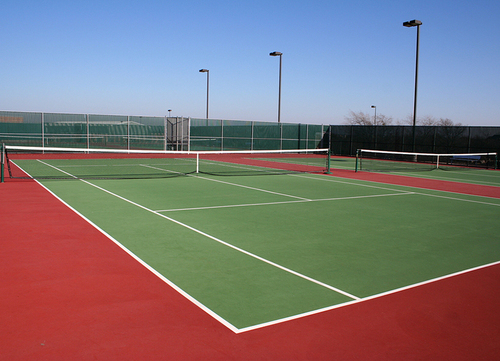
Synthetic flooring performs well across climates when the correct materials are used.
Hot Climate
- UV-resistant acrylic
- Heat-reflective colors
- Crack-resistant base
Humid & Rainy Climate
- Strong drainage system
- Anti-fungal coatings
- Moisture-resistant base
Choosing climate-appropriate materials increases lifespan significantly.
Future Trends in Synthetic Tennis Court Flooring (2026 & Beyond)
- Eco-friendly water-based systems
- Smart surface monitoring
- Enhanced cushioning technology
- Sustainable raw materials
- Faster-curing coatings
These innovations aim to improve sustainability, performance, and durability.
Conclusion
Synthetic tennis court flooring is a versatile, durable, and performance-driven surface solution suitable for clubs, schools, academies, and recreational venues. Choosing the right type, working with experienced installers, and following recommended maintenance practices will ensure long-lasting performance and player satisfaction.
FAQ’s
What exactly is a “Synthetic” or “Acrylic” Tennis Court?
A synthetic acrylic tennis court is a high-performance playing surface composed of multiple layers of specialized acrylic resins. Unlike a simple coat of paint, these systems include primers, resurfacers, and color coats mixed with fine silica sand to provide a specific texture, grip, and consistent ball bounce.
How long does a synthetic acrylic tennis court last?
With proper installation and minimal maintenance, a high-quality synthetic court typically lasts between 5 to 8 years before it requires resurfacing. The structural base (asphalt or concrete) can last 20+ years if built correctly.
Is it possible to make the court softer for player safety?
Yes. By installing a Cushion System, we add multiple layers of rubber-filled acrylic between the base and the color coats. This significantly increases shock absorption, reducing the impact on players’ joints (knees, ankles, and lower back) without affecting the true bounce of the ball.
Can synthetic acrylic courts withstand the Indian climate?
Absolutely. Modern acrylic systems from Pacecourt are engineered with UV-resistant pigments. This prevents the vibrant colors from fading under intense sunlight and ensures the surface doesn’t crack or peel during heavy monsoon rains or extreme temperature fluctuations.
Can an existing old court be converted to a synthetic acrylic surface?
Yes. As long as the underlying base (concrete or asphalt) is structurally sound, we can repair cracks, level the surface with a resurfacer, and apply a brand-new multi-layer acrylic system.