
Tennis court construction in India is growing rapidly across schools, sports academies, real estate projects, clubs, and private villas. However, building a high-quality tennis court is not just about applying surface paint. It involves proper civil work, scientific layering, drainage planning, surface selection, and compliance with ITF standards.
This complete guide explains how to build a tennis court in India step-by-step, including cost, materials, construction timeline, and common mistakes to avoid.
Table of Contents
Standard Tennis Court Size in India
Before construction begins, correct planning is critical.
| Type | Dimensions |
|---|---|
| Singles Court | 23.77 m × 8.23 m |
| Doubles Court | 23.77 m × 10.97 m |
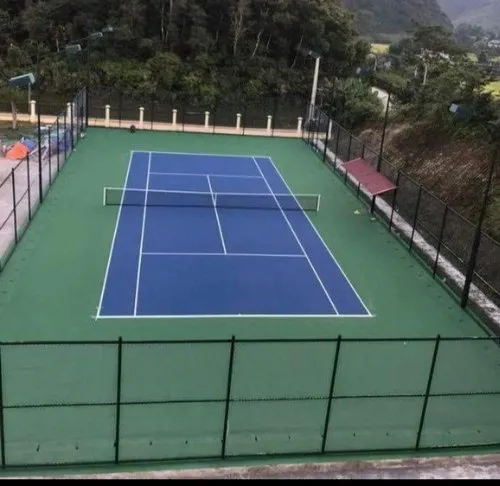
| Recommended total area (with run-off) | 36.6 m × 18.3 m (120 ft × 60 ft) |
✔ Net height: 3 ft at centre, 3.5 ft at posts
✔ Orientation: North–South (to avoid sun glare)
Step-by-Step Tennis Court Construction Process
1. Site Inspection & Soil Testing
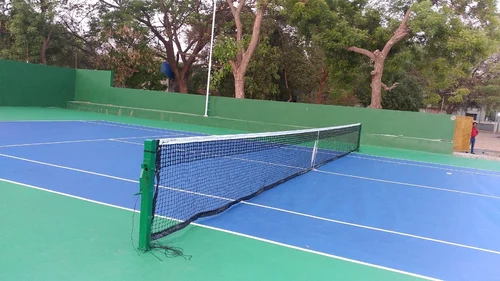
This stage decides the life of the tennis court.
Engineers check:
- Soil strength
- Water table level
- Drainage flow
- Available space & slope
In India, weak soil and poor drainage are major reasons courts crack early. A proper survey prevents future repair costs.
2. Excavation & Base Preparation
Typical excavation depth: 300 mm – 450 mm
Layers usually include:
- Compacted sub-grade
- Granular sub-base (GSB / WMM)
- Stone aggregate layer
- Asphalt or concrete base
✔ Laser leveling is done to maintain slope
✔ Slope requirement: 1:100 to 1:80 for surface drainage
3. Choosing the Right Tennis Court Base
🔹 Asphalt Base (Most common in India)
- Flexible
- Cost-effective
- Faster construction
- Ideal for acrylic surfaces
🔹 Concrete Base
- Stronger
- Longer curing time
- Higher initial cost
- Preferred for premium or indoor projects
90% of outdoor tennis courts in India use asphalt base + acrylic surface system.
4. Surface Selection (Most Important Step)
Popular tennis court surfaces in India:
✅ Synthetic Acrylic Flooring (Best choice)
- Weather-resistant
- UV-stable
- Anti-skid
- Low maintenance
- ITF approved systems available
Other options:
- Synthetic clay
- Artificial grass
- PU systems (mostly indoor)
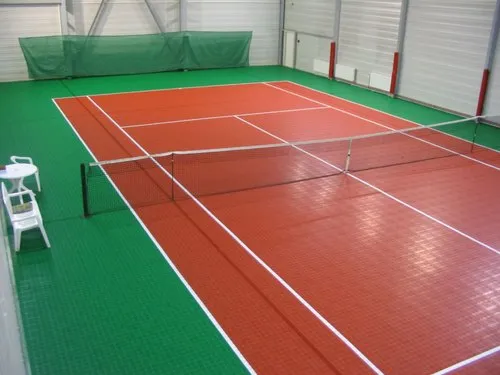
- Modular tiles (training/recreational)
Most professional and school projects use cushioned or non-cushioned acrylic tennis court systems.
5. Acrylic Tennis Court Flooring Application
Typical layer structure:
- Primer coat
- Acrylic resurfacer
- Crack filling & leveling
- Cushion layers (optional)
- Acrylic color coats
- Anti-skid texture layers
- ITF line marking
- Final curing
✔ Each coat is applied using rubber squeegees
✔ Drying time between layers is climate-dependent
6. Line Marking & Accessories
Final stage includes:
- ITF-standard line marking
- Net posts & net installation
- Fencing
- LED sports lighting
- Benches, umpire chairs, wind screens
Materials Required to Build a Tennis Court
Civil & base materials:
- Stone aggregates
- GSB / WMM
- Asphalt or RCC concrete
- Crack fillers
- Expansion joint materials
Surface materials:
- Acrylic primer
- Acrylic resurfacer
- Cushion rubber layers
- Acrylic color coating
- Anti-skid silica sand
- Line marking paint
Accessories:
- Tennis net system
- Fencing (GI or PVC coated)
- Flood lights
- Drain covers
Tennis Court Construction Cost in India (2026 Guide)
Approximate outdoor tennis court cost:
| Type of Court | Cost per sq. ft |
|---|---|
| Basic acrylic court | ₹70 – ₹110 |
| Cushioned acrylic court | ₹110 – ₹180 |
| Premium tournament court | ₹160 – ₹250+ |
Full project estimate:
A standard tennis court (7200–8000 sq.ft) may cost:
👉 ₹6 lakh to ₹18 lakh+, depending on:
- Soil condition
- Base thickness
- Cushion layers
- City/location
- Lighting & fencing
- Brand/system used
Drainage, base quality, and coating system affect cost more than surface paint
Tennis Court Construction Timeline
| Stage | Time Required |
|---|
| Site work & excavation | 5–7 days |
| Base construction | 10–15 days |
| Asphalt curing | 7–10 days |
| Acrylic flooring system | 5–8 days |
| Accessories installation | 3–5 days |
Climate Considerations in India
Tennis courts in India face:
- High UV exposure
- Extreme heat
- Heavy monsoons
- Ground moisture
So a good tennis court must include:
- Proper slope
- Water-resistant acrylic systems
- Expansion joints
- UV-stable top coats
- Crack control fabric (recommended)
Common Tennis Court Construction Mistakes
Avoid these costly errors:
❌ Weak base preparation
Leads to cracking within 1–2 years.
❌ No proper drainage
Causes water logging, algae growth, peeling.
❌ Using low-quality acrylic material
Results in fading, slipperiness, fast wear.
❌ Ignoring slope standards
Creates water patches and unsafe play.
❌ No expansion joints
Causes uncontrolled surface cracks.
❌ Untrained contractors
Courts fail faster due to incorrect layering.
Maintenance Tips After Construction
To maximize court life:
- Weekly cleaning with water
- Remove leaves, mud, and debris
- Annual inspection
- Crack sealing if required
- Recoating every 4–6 years
With good maintenance, acrylic tennis courts in India last 7–10+ years.
Benefits of Professional Tennis Court Construction
Correct ball bounce
Injury-safe surface
Longer surface life
ITF compliance
Lower long-term maintenance cost
Better player experience
Final Thoughts
Building a tennis court in India is an engineering + sports science project, not just flooring work. A successful tennis court depends on:
✔ Proper soil & base
✔ Correct surface system
✔ Climate-suitable materials
✔ Experienced installation
✔ Regular maintenance
If done correctly, a tennis court becomes a long-term sports asset for schools, academies, clubs, and real estate developments.
FAQ’s
How much does it cost to build a tennis court in India?
The cost to build a tennis court in India usually ranges from ₹6 lakh to ₹18 lakh+ for a standard outdoor court. On a per square foot basis, it is approximately ₹70 to ₹250+ per sq. ft., depending on the base construction, surface system, location, drainage, lighting, and accessories.
How long does it take to construct a tennis court in India?
A complete outdoor tennis court typically takes 4 to 7 weeks to construct. This includes site work, base construction, curing, acrylic surface application, and installation of fencing and lighting. Monsoon season may extend the timeline.
What is the best surface for outdoor tennis courts in India?
Synthetic acrylic flooring is the most preferred surface for outdoor tennis courts in India because it is UV-resistant, anti-skid, weatherproof, cost-effective, and low maintenance, and is suitable for Indian climatic conditions.
What is the standard size of a tennis court in India?
The playing area is 23.77 m × 10.97 m (doubles). Including run-off space, the recommended total area is about 36.6 m × 18.3 m (120 ft × 60 ft) as per ITF standards.
Is soil testing required before tennis court construction?
Yes. Soil testing and site inspection are very important to determine load-bearing capacity, drainage design, and base thickness. Skipping this step often leads to cracks and early surface failure.