
Understanding the tennis court size and tennis court flooring is essential for players, coaches, and facility owners. Proper measurements and flooring ensure fair play, consistent training, and safe gameplay. Whether you’re building a new court, checking your local facility, or preparing for tournaments, knowing the official dimensions, surface types, and layout is critical.
Table of Contents
What Is a Tennis Court?
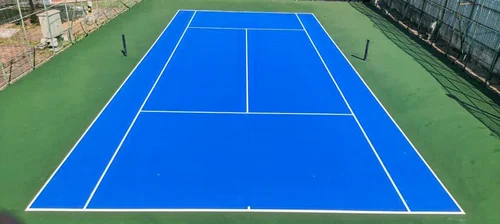
A tennis court is a rectangular playing surface divided by a net in the middle. Matches can be played as singles (1 vs 1) or doubles (2 vs 2), with specific measurements for each type. The court’s size, net height, markings, and tennis court flooring are regulated by the International Tennis Federation (ITF) to maintain fairness worldwide.
Official Tennis Court Size (ITF Standards)
According to the International Tennis Federation (ITF) standards, the official size of a tennis court is:
Dimensions
- Length: 23.77 meters (78 feet)
- Width:
- Singles: 8.23 meters (27 feet)
- Doubles: 10.97 meters (36 feet)
Key Areas
- Service Boxes: Divided into two equal halves by the center service line, each box measures 6.40 meters (21 feet) long and 4.11 meters (13.5 feet) wide.
- Baseline to Net: The net is placed at the center, dividing the court into two equal halves, with the baseline located 11.89 meters (39 feet) from the net on each side.
Net Height
- At the Center: 0.91 meters (3 feet)
- At the Posts: 1.07 meters (3.5 feet)
These measurements ensure consistency and fairness in gameplay across all ITF-sanctioned matches.
Singles vs. Doubles Court Differences
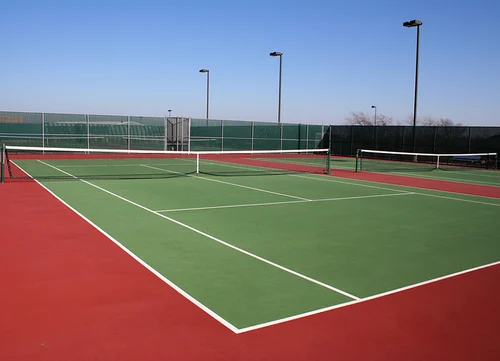
The main difference between singles and doubles tennis courts lies in the width of the playing area:
Singles Court
- Width: 8.23 meters (27 feet)
- The sidelines for singles are closer to the center, creating a narrower court.
- Only the inner sidelines are used for gameplay.
Doubles Court
- Width: 10.97 meters (36 feet)
- The full width of the court, including the outer alleys (doubles alleys), is used.
- This provides more space for two players on each side.
Key Similarities
- The length (23.77 meters / 78 feet) and net height remain the same for both singles and doubles.
- Service boxes and baseline positions are identical.
In summary, the doubles court is wider to accommodate the additional players, while the singles court is narrower for one-on-one play.
Net Height & Placement
- At the Center: 0.91 meters (3 feet)
- At the Posts: 1.07 meters (3.5 feet)
Placement
- The net is stretched across the width of the court, dividing it into two equal halves.
- It is anchored to two posts placed 0.914 meters (3 feet) outside the doubles sidelines on both sides.
- For singles matches, a singles stick is used to maintain the correct net height at the singles sidelines.
Proper net height and placement are essential for fair play, ensuring the ball clears the net consistently during rallies and serves.
Service Boxes & Markings
Service Boxes
- Dimensions: Each service box measures 6.40 meters (21 feet) long and 4.11 meters (13.5 feet) wide.
- Placement: The service boxes are located on either side of the net, within the baseline and the center service line.
Key Markings
- Center Service Line: Divides the court into left and right service boxes.
- Baseline: The back boundary line where players serve from.
- Sidelines: Define the width of the service boxes.
- Service Line: Parallel to the net, marking the front boundary of the service boxes.
These markings ensure accurate serves and help players and officials determine valid service areas during gameplay.
Run-off Areas & Safety Zones
Run-Off Areas
- Definition: The space surrounding the court, providing players room to move safely beyond the playing lines.
- Recommended Dimensions (ITF Standards):
- Behind the Baseline: Minimum 6.4 meters (21 feet).
- At the Sides: Minimum 3.66 meters (12 feet).
Safety Zones
- Purpose: Prevent collisions with fences, walls, or spectators and allow players to chase balls without risk.
- Additional Space: Larger run-off areas are recommended for professional matches to accommodate high-speed play and diving attempts.
Proper run-off areas and safety zones are essential for player safety and ensure uninterrupted gameplay.
Tennis Court Size for Different Court Types
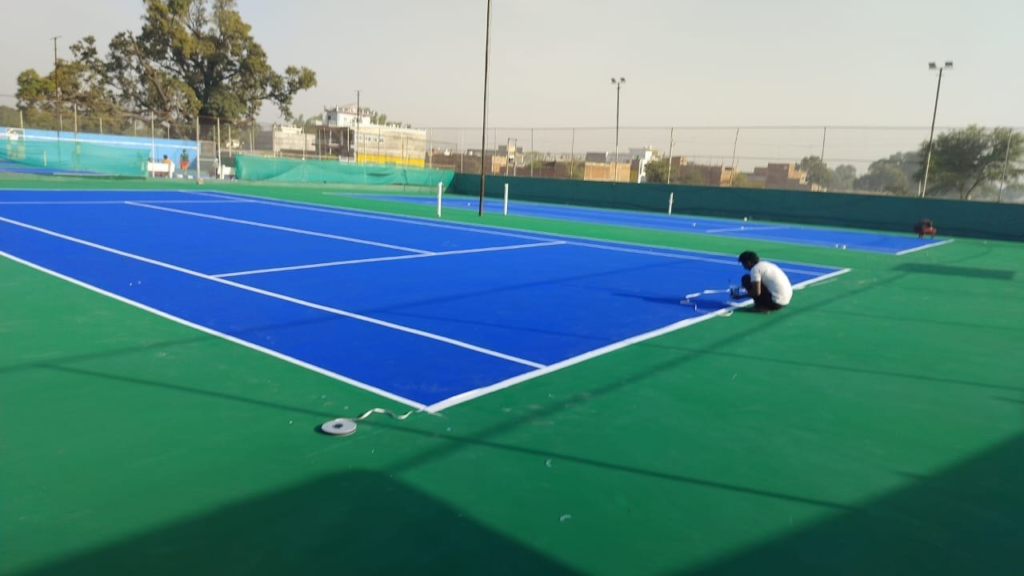
The size of a tennis court remains consistent across all court types (grass, clay, hard, or artificial surfaces) as per ITF standards. However, the surface material affects gameplay. Here’s an overview:
Standard Court Dimensions (All Types)
- Length: 23.77 meters (78 feet)
- Width:
- Singles: 8.23 meters (27 feet)
- Doubles: 10.97 meters (36 feet)
- Net Height:
- Center: 0.91 meters (3 feet)
- Posts: 1.07 meters (3.5 feet)
Court Types
- Grass Courts:
- Natural grass surface.
- Fast gameplay with low ball bounce.
- Clay Courts:
- Made of crushed stone, brick, or shale.
- Slower gameplay with higher ball bounce.
- Hard Courts:
- Typically asphalt or concrete with acrylic coating.
- Medium-paced gameplay with consistent bounce.
- Artificial/Carpet Courts:
- Synthetic materials or removable surfaces.
- Varies in speed and bounce.
While the dimensions stay the same, the surface type influences player movement, ball speed, and bounce characteristics.
Mini Tennis & Junior Court Dimensions
Mini tennis and junior courts are designed for younger players, with smaller dimensions to suit their skill levels and physical abilities. Here’s an overview:
Mini Tennis Court Dimensions
- Length: 11 meters (36 feet)
- Width: 5-6 meters (16-20 feet) depending on the age group.
- Net Height: 0.8 meters (2.6 feet) at the center.
Junior Tennis Court Dimensions (Based on Age)
- Red Stage (8 & Under):
- Court Size: 11m x 5-6m (36ft x 16-20ft).
- Net Height: 0.8m (2.6ft).
- Orange Stage (9 & Under):
- Court Size: 18m x 6.4m (60ft x 21ft).
- Net Height: 0.91m (3ft).
- Green Stage (10 & Under):
- Full-sized court: 23.77m x 8.23m (78ft x 27ft).
- Standard net height.
These scaled-down courts help young players develop skills and confidence before transitioning to full-sized courts.
Indoor vs Outdoor Tennis Court Size
The size of indoor and outdoor tennis courts is identical, adhering to ITF standards. However, the surrounding space and conditions differ:
Court Dimensions (Same for Both)
- Length: 23.77 meters (78 feet)
- Width:
- Singles: 8.23 meters (27 feet)
- Doubles: 10.97 meters (36 feet)
- Net Height:
- Center: 0.91 meters (3 feet)
- Posts: 1.07 meters (3.5 feet)
Key Differences
- Run-Off Areas:
- Indoor courts often have limited run-off space due to building constraints.
- Outdoor courts typically have larger run-off areas for safety.
- Lighting:
- Indoor courts rely on artificial lighting.
- Outdoor courts use natural light, with additional floodlights for evening play.
- Surface:
- Indoor courts are usually hard or carpeted.
- Outdoor courts can be grass, clay, or hard surfaces.
While the court size remains the same, the environment and playing conditions vary significantly between indoor and outdoor settings.
Why Standard Court Size Matters
Standardized tennis court sizes are essential for maintaining fairness, consistency, and quality in the sport. Here’s why they matter:
1. Fair Play
- Ensures all players compete under the same conditions, regardless of location or event.
2. Skill Development
- Players can practice and refine techniques (e.g., serving, volleying) on a consistent court size.
3. Rule Compliance
- Official matches, tournaments, and rankings rely on uniform court dimensions to uphold regulations.
4. Player Adaptability
- Standard sizes allow players to transition seamlessly between courts worldwide.
5. Spectator Experience
- Consistent court dimensions ensure predictable gameplay, enhancing the viewing experience.
In short, standard court sizes uphold the integrity of the sport, ensuring fairness and consistency for players, officials, and fans alike.
Common Mistakes in Measuring Tennis Courts
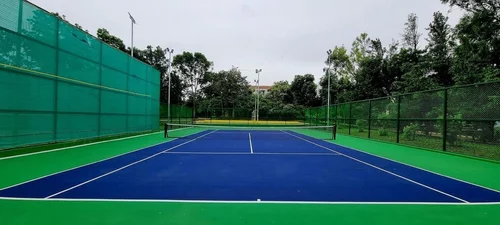
Measuring a tennis court accurately is crucial for compliance with regulations and ensuring fair play. However, common mistakes can lead to improper dimensions. Here are some frequent errors:
1. Incorrect Baseline to Net Distance
- The baseline must be exactly 11.89 meters (39 feet) from the net on each side. Misjudging this can affect gameplay.
2. Misaligned Sidelines
- Sidelines for singles and doubles must be clearly marked and correctly spaced:
- Singles: 8.23 meters (27 feet)
- Doubles: 10.97 meters (36 feet)
3. Improper Service Box Dimensions
- Service boxes must measure 6.40 meters (21 feet) long and 4.11 meters (13.5 feet) wide. Errors here can lead to disputes during serves.
4. Net Height Errors
- The net height must be:
- 0.91 meters (3 feet) at the center.
- 1.07 meters (3.5 feet) at the posts.
- Failing to measure accurately can disrupt gameplay.
5. Run-Off Area Miscalculations
- Insufficient space around the court (e.g., behind the baseline or at the sides) can compromise player safety.
6. Ignoring Slope and Surface Leveling
- Courts must be level and properly sloped for drainage. Uneven surfaces can affect ball bounce and player movement.
7. Using Non-Standard Tools
- Measuring with non-calibrated or imprecise tools can lead to inaccuracies.
8. Overlooking Line Width
- Lines must be 50mm (2 inches) wide, except the baseline, which can be up to 100mm (4 inches).
Avoiding these mistakes ensures the court meets ITF standards, providing a fair and enjoyable experience for players.
Conclusion
Knowing the official tennis court size is vital for building, using, or choosing a proper tennis facility. From net height and service boxes to singles and doubles dimensions, every measurement ensures fair play, safety, and a high-quality experience. Players, coaches, and facility owners should always follow ITF standards to maximize performance and enjoyment.
FAQ’s
What are the official dimensions of a standard tennis court?
A standard tennis court is 23.77 meters (78 feet) long. The width varies for singles and doubles play. For singles, it is 8.23 meters (27 feet) wide, and for doubles, it is 10.97 meters (36 feet) wide.
What is the primary difference between a singles and a doubles court?
The only difference is the width. A doubles court is 2.74 meters (9 feet) wider than a singles court, utilizing the extra space known as the “doubles alleys” on each side. The length and all other markings remain the same.
How high should the tennis net be?
The tennis net must be 1.07 meters (3.5 feet) high at the posts and droop to a height of 0.91 meters (3 feet) at the center.
What are the dimensions of the service boxes?
Each service box is 6.40 meters (21 feet) long and 4.11 meters (13.5 feet) wide. There are four service boxes in total, two on each side of the net.
Are the court dimensions the same for all surface types (clay, grass, hard court)?
Yes, the official court dimensions are the same regardless of the playing surface. While the surface type (clay, grass, or hard court) affects ball speed and bounce, the size of the court remains consistent.