
Building a high-quality tennis court in Assam requires more than picking a surface that looks good on paper. Assam’s heavy monsoon, high humidity, seasonal temperature swings, anad local soil conditions directly affect material choice, drainage design, and long-term maintenance. This guide helps sports facility managers, schools, clubs, and private owners in Assam choose the right tennis court flooring, plan installation, estimate lifecycle needs, and optimise for local conditions — all in a format tailored to rank for search terms like tennis court flooring Assam, tennis court construction Assam, and related queries.
Types of Flooring
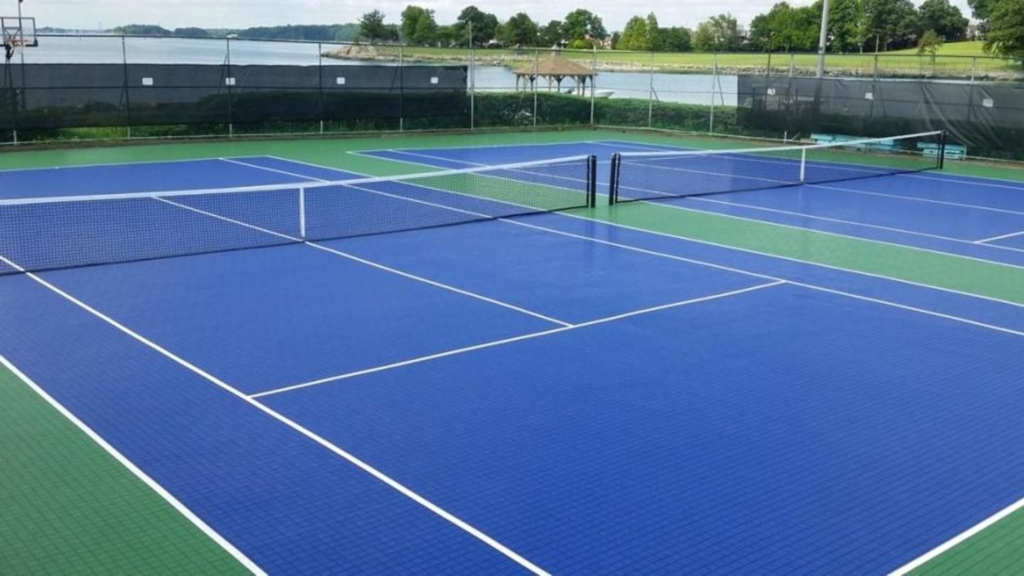
Acrylic (hard courts)
- Description: Multi-layer surface over concrete or asphalt base; popular for public courts and clubs.
- Pros: Durable, low maintenance, excellent ball bounce and speed consistency, cost-effective for many budgets.
- Cons: Can be hard on players’ joints unless shock pads are used; slippery if drainage is poor.
- Best for Assam when combined with high-quality drainage and UV-stable acrylics.
Synthetic / Modular Tiles (interlocking PP/PE tiles)
- Description: Interlocking plastic tiles with shock absorption; installed over compacted base or concrete slab.
- Pros: Excellent shock absorption, quick installation, easy to replace panels, good water drainage through gaps.
- Cons: Variable ball speed depending on tile specification; can be damaged by extreme heat if low quality.
- Best for: Multi-use facilities, schools, temporary courts, or places needing fast installation and good drainage.
Artificial Turf (sand-filled or carpet)
- Description: Synthetic grass systems designed for tennis, often with sand infill.
- Pros: Softer on joints, consistent play, aesthetic appeal.
- Cons: Requires specialised maintenance (brushing, sand top-up). Not ideal where heavy rainfall causes waterlogging unless excellent drainage is provided.
Porous Acrylic / Permeable Surfaces
- Description: Similar to acrylic but designed to allow water to drain through the surface into a sub-base.
- Pros: Faster dry times after rain, ideal for wet climates.
- Cons: Slightly higher installation attention and initial cost.
Clay (red or green clay)
- Description: Traditional clay courts made from crushed brick or specific clays.
- Pros: Player-friendly, softer landings, slower game pace.
- Cons: Highly maintenance intensive; not ideal where heavy rain and flooding are common without constant maintenance.
Assam-specific considerations (climate, soil, drainage, seasonality)
Heavy monsoon & drainage: Assam receives intense seasonal rainfall. Use permeable surfaces, engineered sub-bases, and raised slabs with efficient perimeter drains to avoid long downtime after rain. Prioritise porous acrylic or modular tiles if quick drainage is critical.
Humidity & material durability: High humidity accelerates some adhesive failures and encourages biological growth (moss/algae). Choose UV- and humidity-resistant coatings, and specify mildew-resistant materials.
Flooding and riverine soils: In flood-prone or alluvial areas near the Brahmaputra, evaluate site elevation and consider raised foundations or flood-proofing measures.
Temperature swings: While Assam is mostly tropical, surfaces should still tolerate local temperature ranges without crazing or shrinkage.
Construction seasonality: Plan major civil works in the dry months to avoid monsoon delays — coordinate with contractors for a dry-window construction schedule.
Site selection & pre-construction checklist
Orientation: North–south orientation minimises sun glare for players during morning/evening sessions.
Soil investigation: Do a geotechnical assessment for bearing capacity and groundwater level—this drives base design.
Drainage design: Include perimeter drains, slope gradients (minimum 1:100 where applicable), and a well-engineered sub-base to handle monsoon runoff.
Access & utilities: Ensure access for heavy equipment and supplies, water supply for cleaning, and electricity for lighting if planning night play.
Local approvals: Check with municipal or campus authorities for land-use permits, fencing, and lighting permissions.
Recommended construction process (step-by-step)
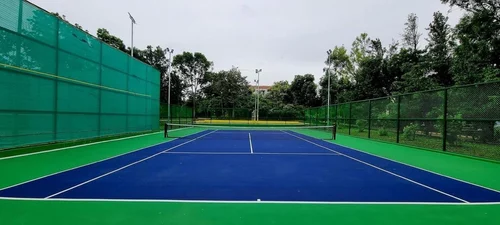
Site clearing & levelling — remove organic topsoil and debris.
Subgrade preparation — compacted and stabilised earth; treat soft pockets with stone or geotextile.
Sub-base installation — layers of M-sand, crusher run, and graded aggregate compacted in lifts; thickness depends on soil and expected loads.
Base layer — pour asphalt (bituminous) or concrete slab (typical if using acrylic surfaces). Proper curing is essential.
Primer / tack coat (if needed) — prepares base for the surface.
Shock pad (optional) — rubberised underlay for player comfort and longevity.
Surface system — application of acrylic layers, modular tile placement, or turf installation per manufacturer specs.
Court markings and net post installation.
Drainage & perimeter finishing — ensure drains, scuppers and gutters are in place.
Commissioning & play testing — check ball bounce consistency, surface evenness, and drainage performance.
Maintenance plan for Assam (keep your court playable)
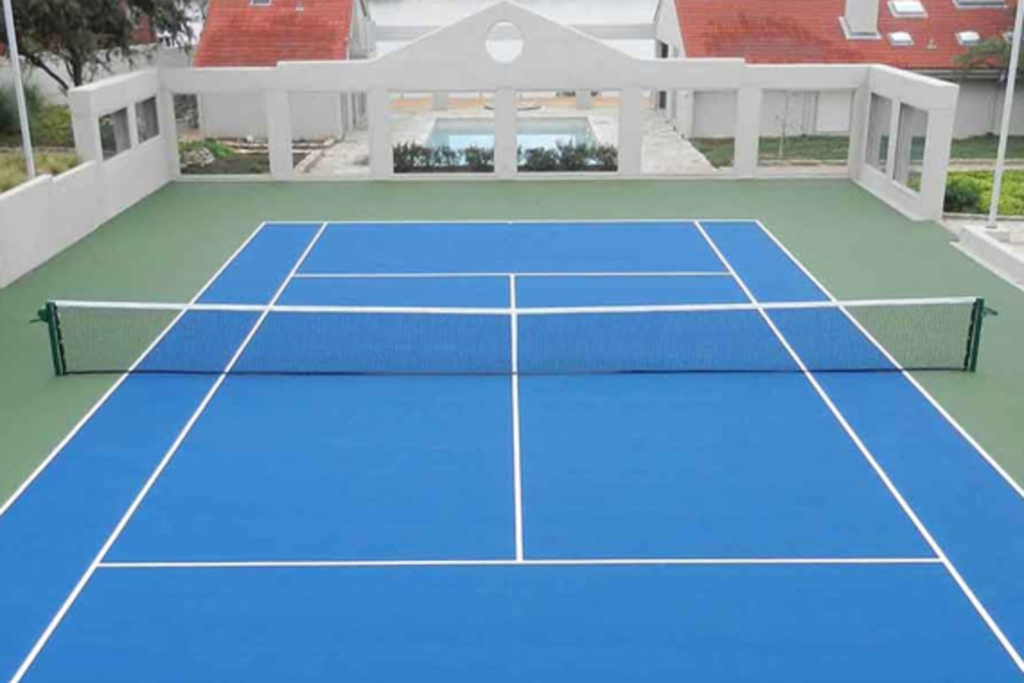
Daily/weekly: Sweep or use blower after heavy leaves/debris; remove standing water from localized spots.
Monthly: Inspect surface for cracks, loose tiles, or seam issues; clean algae/moss early with manufacturer-approved treatments.
Annually: Repaint lines and apply a maintenance/top coat for acrylic surfaces; deep brushing and infill top-up for turf.
After monsoon: Inspect drainage and repair any sub-base washouts or erosion near court edges.
Long-term (every 7–12 years): Resurfacing or replacement depending on wear — schedule a professional audit.
Common problems in Assam and how to avoid them
- Slow drying after rain: Use permeable surfacing or upgrade drainage.
- Biological growth (moss, algae): Improve sunlight exposure, use anti-fungal treatments, and schedule power washing.
- Edge erosion and washouts: Install protective curbs and soil stabilisation around perimeter drains.
- Poor bounce due to base movement: Proper compaction and certified base design prevent differential settlement.
Cost factors (what affects price) — what to ask your vendor
Rather than fixed prices (which vary widely), ask vendors about:
- Type of base (asphalt vs concrete) and its thickness.
- Whether a shock pad is included.
- Surface material brand and warranty details (UV & humidity warranty).
- Drainage system specifics (perimeter drains, sub-surface drains).
- Labour and transport to your Assam location (logistics can add cost).
- Maintenance package or annual service contracts.
Conclusion
Choosing the right tennis court flooring in Assam is a long-term investment that directly impacts play quality, safety, and maintenance costs. With the state’s heavy monsoon rains, high humidity, and varied soil conditions, selecting a climate-appropriate surface—such as acrylic with proper drainage, porous systems, or high-quality synthetic flooring—is essential for durability and year-round usability. Just as important is professional site preparation, engineered drainage, and adherence to standard construction practices to prevent common issues like waterlogging, surface cracks, and uneven bounce.
By partnering with experienced tennis court contractors, using certified materials, and following a structured maintenance plan, schools, sports clubs, academies, and private owners in Assam can ensure a high-performance court that lasts for years. Whether you are planning a new tennis court construction or upgrading an existing one, investing in the right flooring solution today will deliver consistent play, lower lifecycle costs, and a professional playing experience for the future.
Which tennis surface dries fastest after monsoon rains?
Permeable or porous acrylic surfaces and modular interlocking tiles with engineered sub-bases dry faster than traditional sealed acrylic over dense base. Good perimeter drainage is critical.
How long does a tennis court last in Assam?
Lifespan varies by material and maintenance. A well-built acrylic court can last 10–15 years before significant refurbishment; modular tiles and synthetic turf have variable lifespans depending on use and upkeep
Can a tennis court be used year-round in Assam?
Yes, with proper drainage and maintenance. Scheduling major civil work in the dry season reduces downtime during construction.
Do I need flood protection for a court near the Brahmaputra?
If the site is in a flood-prone zone, raise the court elevation, employ flood-resistant sub-base designs, or consider temporary modular surfaces that can be replaced after flooding.